


Every Notification Ask Your Brain to Start Over
 Keerthivasan•August 6, 2026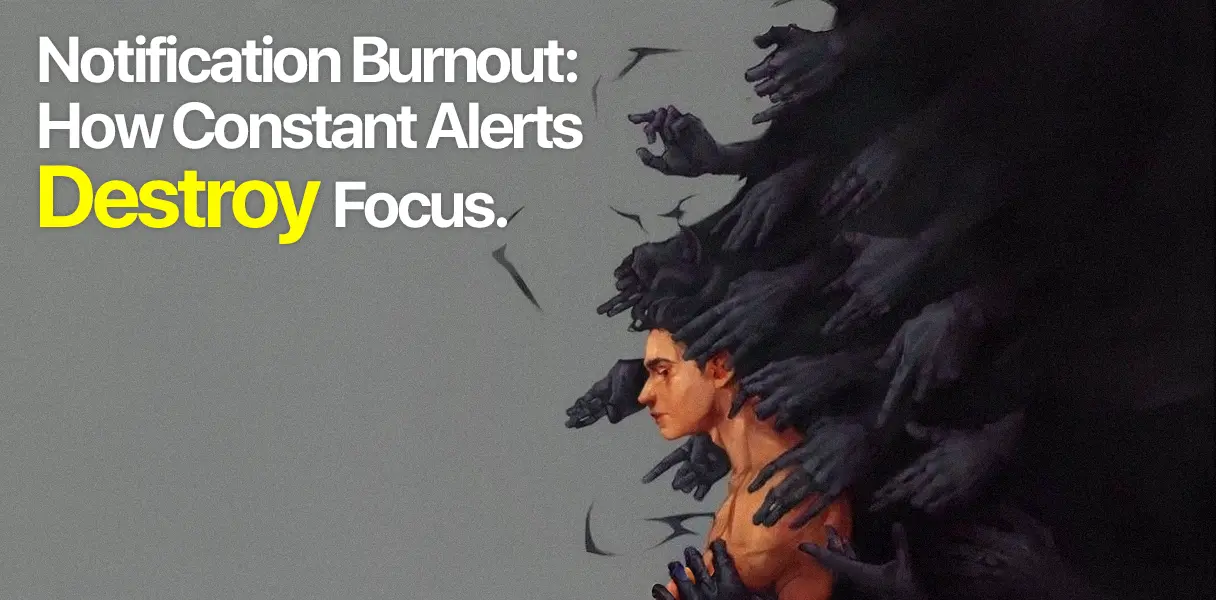
Why Notification Burnout is Quietly Stealing Your Focus
You sit down to finish an important task. Five minutes later, slack lights up. Then an email arrives. Your calendar reminds you about a meeting. Your phone buzzes with a delivery update.
Before long, you have opened half a dozen apps and forgotten what you were working on in the first place. By lunchtime you have been busy all morning.
You just haven't made much progress. Most people assume this is a discipline problem. They think they are getting worse at focusing or that they simply need a better productivity system.
The reality is much simpler. Modern work interrupts us far more than it used to.
Productivity Advice Misses the Bigger Problem
When focus starts slipping, most of us reach for familiar advice.
Turn on Do Not Disturb. Try the pomodoro technique.
Block distracting websites. Download another productivity app.
These strategies can help, but they rarely solve the real issue because they focus on changing our behavior instead of changing the environment competing for our attention.
Work no longer lives in one place.
A normal day involves email, slack, microsoft teams, google calendar, documents, notes, reminders, project boards, and video meetings. Every tool wants your attention. Every notification believes it's the most important one.
Your brain has to keep switching between them.
Notification Burnout Is More Than Too Many Alerts
Notification burnout is not simply receiving too many notifications.
It's what happens when your attention keeps being interrupted before it has time to settle.
Every notification asks your brain to stop, decide whether something needs attention, switch context, and then return to what it was doing.
That sounds insignificant. Until it happens fifty times a day. Researchers describe part of this effect as attention residue.
Even after you have returned to your original task, part of your attention stays attached to the email, message, or alert you just checked. Your brain is technically back at work, but it has not completely let go of the interruption.
Multiply that across an entire workday and focus never gets a chance to build momentum.
Why You Feel Mentally Drained
The exhausting part is not one notification. It's constantly restarting.
Imagine reading a book while someone interrupts every few pages with another question. You would eventually finish the story, but it would take far more effort because your brain keeps rebuilding context.
Knowledge work works the same way. Instead of moving deeper into a problem, you are repeatedly finding your place again.
That's why many people finish the day feeling mentally exhausted even though nothing particularly difficult happened.
Your brain spent the day starting over.
The Hidden Cost of Scattered Work
Notifications are not the only problem. Modern work is scattered across too many places.
Tasks live in one app. Notes live in another. Meetings are somewhere else.
Documents, reminders, emails, and messages all compete for attention
Even without a single notification, constantly moving between tools forces your brain to reload context again and again.
Eventually, you feel productive because you are constantly doing something. But activity is not the same as progress.
Your Brain Is Also Waiting for the Next Interruption
One of the less obvious effects of notification burnout is anticipation. After enough interruptions, your brain starts expecting another one.
You check your inbox. You glance at slack. You unlock your phone. Nothing happened. But your attention still shifted.
That constant readiness creates a low level of mental tension that makes it harder to relax, concentrate, or disconnect after work.
The solution is not more willpower
Most people don't need another productivity hack. They need fewer reasons to switch their attention.
That means reducing unnecessary notifications, limiting app switching and creating longer stretches of uninterrupted work.
The environment matters more than motivation. That's one reason some people are moving toward tools that bring scattered work together instead of adding another layer to it.
Rather than jumping between emails, notes, reminders, calendars and tasks all day, platforms like mysamantha.ai reduce some of that digital friction by keeping more of your workflow in one place.
The benefit is not perfect organization. It's asking your brain to restart less often.
Protect Your Attention Like It Matters
Some notifications deserve immediate attention. Most don't, the goal is not complete silence.
It's deciding what truly deserves to interrupt your thinking.
Your attention is one of your most valuable resources. Every unnecessary interruption chips away at it a little more.
Tools like mysamantha.ai won't eliminate every distraction. But reducing the number of places your work lives can make it easier to stay focused on what actually matters instead of constantly chasing the next notification.
Because your best work rarely happens between interruptions.
It happens when your brain has enough uninterrupted time to finish one thought before another notification asks it to start over.
The Best Way to Manage Follow Ups After Meetings
Learn how to manage meeting follow-ups with clear actions, owners, deadlines, and context so your team can maintain momentum and turn decisions into results.


How to Turn Emails Into Tasks Without Losing Context
Learn how to turn emails into clear tasks while keeping important context, deadlines, and follow-ups connected so you can stay organized and focused.

Picking the Right Fitness Routine Is Harder Than It Sounds
Learn how to choose a fitness routine that fits your goals, schedule, personality, and fitness level so you can stay consistent and enjoy exercise.


Workflow Management: How to Manage the Team on Updates
Learn how workflow management helps teams improve visibility, clarify ownership, reduce unnecessary updates, manage delays, and work more efficiently.


How to Stop Doomscrolling: The Definitive Guide to Breaking the Habit
Learn how to stop doomscrolling by identifying triggers, adding friction, replacing endless scrolling with finite activities, and protecting your mornings and bedtime.


Daily Planning Routine: Plan Less, Finish More
Build a simple daily planning routine that helps you prioritize, protect your focus, handle interruptions, and finish what matters.


Make MySamantha yours.
Start with Notes, Tasks and Journal. Connect your email and calendar when you're ready. Invite Samantha in when you want help. Use as much, or as little, as you need.